DISCLAIMER: This post is offered as a personal perspective on the market and the sentiment of the FIRE community & influencers as of August, 2026. This is not a doomsday post nor is it in any way investment advice. It’s merely observations from the Professor – a guy that wrote his first online retirement calculator in 2000, recently retired, and has weathered a few financial storms. As always, consult a professional before doing anything crazy with your money.
Introduction
It’s hard to find FI/FIRE information that doesn’t downplay the possibility of a market downturn. Sure, we acknowledge that there will ultimately be downturns. But we often dismiss these worries by saying things like “just zoom out on the stock market graph and you’ll see the long-term trend is always up”. And we follow that up with “so just don’t sell and you’ll be fine”. By the way, both of those things are solid advice; I’m not disputing either one.
But, what if the market dropped 50% and took 7 years to recover to breakeven? What if it then immediately dropped 57% again and took another 4 years to recover? Sound crazy? Well, that’s exactly what happened to the S&P 500 between 2000 and 2013. That’s 13 years of flat earnings!
NOTE: the recovery timeframes above are based on price only. Reinvesting dividends during these timeframes would have shortened the breakeven windows.
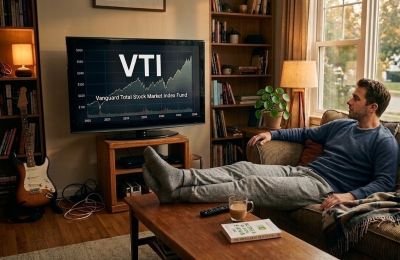
“VTI and Chill” – The FIRE Community Motto
VTI is the Vanguard Total Stock Market Index fund. It owns stock in every publicly traded U.S. company. If you own shares of VTI, then you own shares of every U.S. company. Further, because it’s an index fund, as opposed to an actively managed fund, it has a very low expense ratio (i.e. it’s cheap to own). VTI’s U.S. focus, diversity, low cost, and solid performance has made this fund the darling of the FIRE community. So the FIRE community’s investment advice is often “VTI and chill” – meaning, that all you have to do is invest in VTI and leave it alone. And if you’ve done this since the FIRE movement really took off around 2014, you’ve done VERY well for yourself.
NOTE: VTSAX is the mutual fund version of VTI – same thing just not traded on a public exchange. So, you’ll often hear “VTSAX” and “VTI” used interchangeably. You can consider them equivalent for the purposes of almost all FIRE conversations.
But is “VTI and chill” still sound advice? I have a couple of concerns that I think are worth considering:
Concern 1: The FIRE Movement’s (Over)Confidence
The FIRE movement exploded around 2014 when the term “FIRE” was coined. See 022 | What is FI / FIRE and the Different Types of FIRE?. As such, the community has grown up in an era of almost entirely market recovery and growth. Since 2009 the market has mostly gone up. Covid was the main exception, but its drop was very short; nothing like the “Lost Decade” starting around 2000. Most of the FIRE podcasters/evangelists have never actually seen a real, prolonged market downturn. This isn’t to knock anyone, but it is potentially a real blindspot of the movement.
When an abundance of community advice like “just VTI and chill” comes from influencers that have only seen market upside, it makes me a little leery. And it makes me wonder if the FIRE community is maybe a little overconfident. I’ve lived through Black Monday in 1987, the dot-com bust in 1999, and both the 2000 & 2007 crashes of the “Lost Decade”. So, I tend to have a more conservative outlook than the community as a whole.
Concern 2: Market Valuations – Historically High
A common tool used to evaluate the price of a stock is the P/E ratio. The P/E ratio (price-to-earnings ratio) compares a company’s stock price to its profit. It is simply a company’s current stock price divided by its earnings per share.
P/E Ratio = Stock Price / Earnings Per Share
I remember a certain young Professor trying to understand investing in the 1990s and consistently reading that a P/E ratio of 13 or less indicated a reasonable buy. Higher than 13 was a sign to not buy or proceed with caution. Fast forward to today and the current P/E ratio of the S&P 500 is around 26!
NOTE: I’m talking about the traditional trailing P/E ratio here, not the Shiller P/E Ratio (CAPE).
This indicates that stocks are likely overpriced. That means there better be a LOT of good news (i.e. profits) in the future in order to justify the current prices. For the sake of argument, let’s assume there are large earnings coming. While that could justify the current prices, is there any room left for stock prices to grow? There may be, but some skepticism is probably warranted.
Concern 3: Similarities to the 1999 Dot-Com Bust
You’ve no doubt heard the hype about Artificial Intelligence. There’s a huge bet on AI currently. Massive amounts of venture capital is being poured into AI companies. Further, many of these companies are not profitable nor expected to be for at least 3+ years. Yet, their stock prices have risen significantly.
Of additional concern, this venture capital money is fueling other AI-adjacent companies. Take Nvidia, for example. Nvidia stock has exploded as it has expanded to meet the chip demands of AI. Nvidia currently is the top-weighted company in both the S&P 500 and in VTI with approximately 8.5% of the S&P 500’s total market value and about 6.5% of VTI’s total market value. And there are many other industries benefiting from this AI spending craze: data centers, chipmakers, cooling systems, cables, energy providers, cybersecurity, and more. What happens to these companies if the AI companies don’t turn a profit and the venture capital injections halt?
There’s a real parallel to be drawn between now and the dot-com bubble of 1999. Dot-com companies were wildly overvalued and buying & selling services to each other. This made the industry look more profitable than it actually was and ultimately it came crashing down. I’m not saying we’re going to have a Dot-com scale crash, but the similarities are too great to completely dismiss in good conscience.
Hold On – Stay Tuned
That wraps up my large concerns regarding the simple “VTI and chill” advice. But, before you walk away sad and defeated, please don’t. This post is part 1 of 2 where I just focused on concerns. In the next post, I’ll focus on the positives. It’s the old question: “I have good news and bad news; which do you want first?”. I just answered for you and my answer was “hit us with the bad”. The next post will be “and now the good news”.
While you’re anxiously awaiting that next post, check out our free FI calculator.
Hang tight, FI friend!
P.S. – if you like this post (or any FIcology content), please share with a friend and follow us on Facebook.