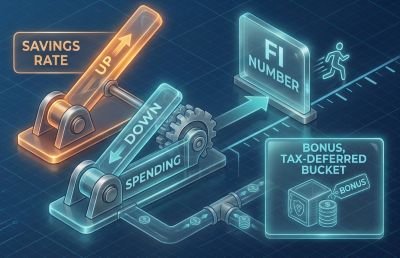
Spreadsheet Surprise
One day along my FI journey, I was playing with different retirement scenarios in a spreadsheet when I was pleasantly surprised by a deceptively simple fact that I’d completely missed:
Every dollar you save annually is a dollar you don’t spend annually.
“Well, duh”, you’re probably thinking; “that’s your big epiphany?!” Stick with me for a bit longer and I’ll clarify the double benefit.
Benefit One: Accelerating Towards Your FI Number
If you’ve been around FI/FIRE much at all, you know the term “FI Number”. It’s simply the dollar amount needed in your portfolio that you can live off of for the rest of your life without working. You’ve also probably heard of the 4% rule. If you haven’t, check out our Introduction to the 4% Rule post. The 4% rule asserts that with the proper portfolio mix and a 30-year retirement timeline, you can safely retire when your living expenses are less than or equal to 4% of your portfolio. A simpler way to state that is: you need 25 x your annual expenses saved to retire. This is called your FI Number. So, every dollar saved/invested moves you towards your FI Number.
Benefit Two: Reducing Your FI Number
As humans we share some common traits. One thing I’ve noticed about myself, and I bet many of you share this as well: I tend to grow my lifestyle into the level of income I have. Since Mrs. FIcology and I got married, we’ve gone from driving used cars and living in apartments to buying new cars and a nicer house. Fortunately for us, we haven’t been “out of control”, but we could have probably moderated some. And that’s where the double benefit of saving for FIRE comes in. Each dollar you save, especially if you have it taken out of your paycheck before you get it, is one dollar less that you can inflate your lifestyle into. It’s one dollar less of annual expenses. So, back to the 4% rule; it tells us we can retire when we reach our FI Number. And our FI Number is 25 x Annual Expenses. If my annual expenses are lower, so is my FI Number, which will shorten my FIRE journey. It’s like pulling two levers instead of just one!
Let’s Math It
To illustrate, let’s do a real example. I’ll keep the numbers simple and assume we’re starting from scratch on our FI journey.
Begin Balance: $0
Annual After-Tax Income: $100,000
I’ll be using the Ficology101 FIRE Calculator to determine our FI Number and Years to FI.
Scenario 1
Annual Spending: $80,000
Annual Savings: $20,000
FI Number (25 x $80,000) = $2,000,000
Years to FI: 30
Scenario 2 (shift $5,000 of annual spending to savings)
Benefit One – Accelerating Savings
Annual Savings: $25,000 ($5,000 higher)
FI Number: $2,000,000 (unchanged)
Years to FI: 28 (2 years faster)
Benefit Two: Reducing FI Number
Annual Spending: $75,000 ($5,000 lower)
FI Number (25 x $75,000) = $1,875,000 ($125,000 lower)
Years to FI: 27 (total of 3 years faster)
I totally get that it’s not easy to shift $5,000 of living expenses. But what if you got a 5% raise and instead of increasing your lifestyle by that same amount, you saved it all? That IS totally realistic and doable!
But Wait, There’s More – Bonus Benefit: Pre-Tax
There’s a third benefit worth mentioning and that is reduced taxes. If your savings are pre-tax (like an employer 401k, for example), then you’re saving income taxes on your current earnings also. Pre-tax savings are eventually taxed when withdrawn, but you’ll likely be in a much lower tax bracket in retirement; maybe 0, effectively avoiding taxes completely. Don’t discount the potential savings from deferring taxes.
Assuming a 22% tax bracket, that $5,000 after-tax additional savings could have been $6,410 pre-tax. Continuing our example above:
Scenario 3 – Pre-Tax Savings $6,410 (equivalent of $5,000 post-tax)
Bonus Benefit: Pre-Tax
Annual Savings: $6,410 ($6,410 higher)
Years to FI: 26 (total of 4 years faster)
Call to Action
I’ve shown you how to get double-, no wait, triple- benefits from every dollar saved. Combine this with the power of compounding (see my post on The Urgency of Now) and you’ve got real motivation to get started on your FIRE journey. Don’t wait, take the time to run your own numbers and see just how much you can accelerate your FI timeline!