The Four Types of Investment Accounts (Buckets)
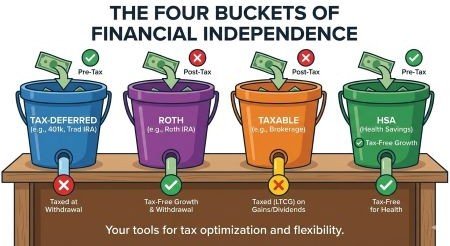
We covered U.S. tax brackets and marginal vs effective tax rates in our previous post: Marginal vs Effective Tax Rates. Before we discuss strategies on maximizing our take-home income, (i.e. “tax bracket arbitrage”), we need to know the tools that enable us to do so. Those tools are the different types of investment accounts available to us. These can loosely be grouped into four types (buckets) that you can store your money in.
Those buckets are: Tax-Deferred, Roth, Taxable, and HSA. We’ll cover each below along with one additional for education: 529.
NOTE: As with all FIcology posts, we’re focusing on U.S. taxes and laws. While other countries may have similar concepts, their discussion is beyond the scope of this post.
1) Tax-Deferred – “I’ll Pay Later”
- Examples: 401(k), 403(b), Traditional IRA
- How it Works: You get a tax break today. Your contributions go in pre-tax, lowering your current taxable income
- The Reward: Your contributions grow tax-free UNTIL you pull them out in retirement. These often have some level of employer-matching contributions.
- The Catch: You cannot withdraw until age 59.5 or face penalties. Withdrawals are taxable.
- FI Context: The most powerful way to reach FI and the number one strategy for earners in the accumulation stage. You avoid paying taxes in a higher tax bracket now, often get matching contributions from your employer, and pay taxes later when you are in a lower tax bracket.
2) Roth – “I’ll Pay Now”
- Examples: Roth IRA, Roth 401(k)
- How it Works: Your contributions go in post-tax. There is no tax-break today.
- The Reward: Your contributions grow tax-free forever. Withdrawals are never taxable. Original contributions can be withdrawn before age 59.5 (although NOT recommended). Employer-sponsored plans may have some employer-matching contributions.
- The Catch: While you can withdraw your original contributions at any time (you’ve already paid taxes on those), you cannot withdraw earnings until age 59.5 or face penalties.
- FI Context: Tax-free growth and withdrawals forever. You can pull from these accounts without increasing your tax bill—a powerful strategy to prevent hitting higher tax brackets pulling from your tax-deferred accounts.
3) Taxable – “I’ll Pay Now and Later”
- Examples: Individual or Joint Brokerage accounts (Vanguard, Fidelity, Schwab, etc.)
- How it Works: There are no tax breaks for contributing, and you pay taxes on interest, dividends, and realized (when you sell) gains.
- The Reward: Accessible any time. No age 59.5 rules, no penalties, and you benefit from lower Long-Term Capital Gains (LTCG) tax rates.
- The Catch: No tax-breaks aside from LTCG (which are significant). You’ll want to favor tax-efficient investments in these accounts.
- FI Context: The ultimate flexibility for withdrawal. Having significant funds here can help you retire before age 59.5 (the age you can access your 401(k) without penalties).
4) Health Savings Account (HSA) – “I’ll Never Pay (for Health)”
- Examples: HSA (employer-sponsored or through financial institution w/eligible Healthcare.gov plans)
- How it Works: You get a tax break today. Your contributions go in pre-tax, lowering your current taxable income.
- The Reward: Tax-free contributions and growth. Accessible any time for health care costs.
- The Catch: Can only be used for healthcare-related costs. Penalties if withdrawn for non-healthcare costs.
- FI Context: This is a literal powerhouse in the FI arsenal. You NEVER pay taxes on this money as long as it’s used for medical-related costs, which we all have. It can even be used for Medicare payments. AND, after age 65, the penalty for non-medical withdrawals disappears. It then acts like a Tax-Deferred account—you just pay income tax on any non-medical withdrawal. This eliminates any concern of overfunding these accounts.
Bonus) 529 – Education Savings
- Examples: 529 plans vary by state. Savings plans for higher education expenses.
- How it Works: Often states give you a break on state income taxes for contributions. Earnings grow tax free.
- The Reward: Tax-free growth. Accessible any time for higher education costs. Powerful savings for your childrens’ college expenses.
- The Catch: Can only be used for higher education-related costs. Penalties if withdrawn for anything else.
- FI Context: Powerful for funding your childrens’ college education, especially if funded early. May not apply to everyone’s FI planning. Plans and rules vary by state. Included here for completeness.
- Pro-Tip: As of 2024, the SECURE 2.0 act allows you to roll over up to $35,000 of unused 529 funds into a Roth IRA for the designated beneficiary (subject to certain rules like the account being 15 years old). This removes some fear of overfunding college savings.
Summary
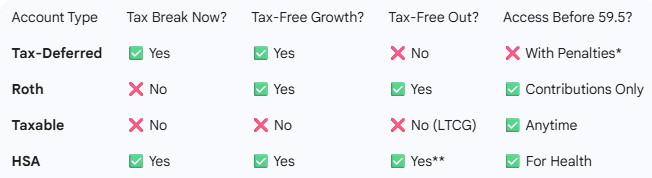
We covered the four main investment account types that make up the tools for your FI journey. This sets us up to talk about “tax bracket arbitrage” in upcoming blog posts. These different account types enable that arbitrage. Below is a brief comparison of these four account types.
Comparison at a Glance
We also briefly covered a fifth type—529 education savings. If funding childrens’ college expenses is in your future, this should be considered in your FI journey as well.