Category: FICology

  • 009 | Community: Life or Death / Boom or Bust

    009 | Community: Life or Death / Boom or Bust

    The Importance of Community – A Personal Warning ⚠️

    If you’re reading a Financial Independence blog, there’s a good chance you’re an independent person, like myself. For me that has meant things like: “I don’t need anyone else”, “I don’t need any help”, and “I can do everything on my own”. For good or bad, our current world of internet, cell phones, delivery services, streaming entertainment, etc. enables independence more than ever, even pushing us in that direction.

    About ten years ago, there was a 5-year period where life really should have been at its peak for me, but I was becoming increasingly depressed. I went to work every day and put on a happy face, but I was steadily crumbling in my personal life. I went through a series of ups and downs while steadily trending downward. Suicide became part of my regular thoughts. I researched methods, came up with a plan and even started executing the plan. It was at that point I decided to seek professional help. I saw a counselor once a week for about a year. He helped me unpack some childhood trauma, understand my negative thought patterns, learn & apply new thought patterns, and most importantly to understand how depression & isolation feed off each other to create a dangerous downhill cycle that can end in death. 

    Although I learned multiple things from counseling, number one for me was that I was lacking people in my life. I can remember my counselor’s words to this day — he said: 

    “[Professor], I think you need a friend”. 

    He was right. As life marched on with career, wife, house, family, and responsibility, my friends had fallen by the wayside; family members had drifted away. As I isolated further over the years, depression started setting in. I had lost much of my community and I hadn’t noticed the gradual decline. 

    Community is a necessity, I found out. And being an introvert by nature, this means I have to be very intentional about seeking and maintaining community. If I neglect this for too long, bad thoughts start creeping into my head again. I have to be quick to recognize this and take action — get out of the house, go talk to people, volunteer for something, anything to get human interaction. 

    The Human Aspect of Community – Life or Death 🛟

    Principle 1 – Humans are tribal creatures. We are hard-wired to require community.

    Social connection is critical to our well-being. It provides emotional and physical support, helps manage stress, promotes physical activity, and improves sleep quality. Studies have shown that married couples and people with strong community ties live longer. We need friendship, companionship, and regular social interaction. 

    Lack of community can have the opposite effects. The CDC lists the following health impacts of social isolation and loneliness:

    • Heart disease and stroke.
    • Type 2 diabetes.
    • Depression and anxiety.
    • Suicidality and self-harm.
    • Dementia.
    • Earlier death.

    Think about it — one of the cruelest punishments for incarcerated individuals is solitary confinement. It’s a horrible experience that often leads to permanent mental issues and even suicide. 

    Never discount the importance of human connection. Surround yourself with friends, family, and community. Don’t wait until you’re aged 50 and depressed like I did. You’ll be healthier and happier.

    The FI Aspect of Community – Bust or Boom 📈

    Humankind has evolved as tribal creatures. Our ancestors depended on a tribe for food, safety, reproduction, and resources. Getting along with, being part of, and helping your tribe were critical to an individual’s success and survival. We are hard-wired to blend-in with, imitate, conform to, and please the members of our tribe. While we don’t really have tribes today, we do have groups & communities. And they can have just as much impact and influence on us as tribes did on our ancestors.

    Principle 2 – You are the average of the 5 people you spend the most time with.

    One of the really cool things about the FI/FIRE movement is the incredible community that it has created. There are podcasts, camps, conferences, forums, local meetups, and more. You’d be hard-pressed to find a more big-hearted, helpful, and life-loving group of people than the FI community. If you want financial independence and to live life to its fullest, there’s no better way than to surround yourself with a community that is focused on achieving that as well.

    Principle 3 – Habits, good or bad, are a product of your environment.

    To reach financial independence and architect the life you want to live, you’ll need to form good habits. FI events and communities are the perfect environments for that. You’ll be regularly reminded of what we’re working towards. You’ll hear success stories of other individuals and the strategies they’ve employed. You’ll find the knowledge and tools needed for financial independence. And member successes are regularly celebrated.

    The path to financial independence has a number of pitfalls that are easily avoided with the help of the FI community. Those pitfalls include: career, legal, taxes, investing, and emotional just to name a few. While potentially detrimental to the lone traveler, they are easily navigable with the help of other travellers, both past and present. This is why the FI community can make the difference between bust or boom.

    Conclusion – Key Takeaways 🔑

    I hope you found this post helpful. It’s a bit more personal than I’m normally comfortable sharing. But I think the message is so important. You are loved. You deserve to be happy and successful. You deserve a life that YOU design where you spend your time the way YOU want. Here are some key takeaways.

    1. See a Counselor at First Sign of Depression

    I resisted seeing a counselor for so long. I thought it was “dumb”, “weak”, “desperate”, “only for crazy people”. I’d argue with my wife “That’s just paying someone to be my friend”. Wow, I was wrong. Depression makes you want to be alone. You’re sad, you don’t want to be around other people, so you isolate yourself. Isolation then makes you more depressed, so you isolate more. And this just spirals downward. It’s a terrible place to be and help is available. A counselor can help you understand this, break the cycle, and so much more. 

    2. Actively Seek and Maintain Community

    We’re tribal creatures and we need our tribe. Unfortunately, today’s world requires continual effort to maintain relationships. Career & family demands take a lot of time leaving little for other relationships. Friends come and go. Family members drift away. And mortality takes all of us eventually. Always keep a set of quality friends. A good friend of mine (who, ironically, has moved away) once told me: 

    “If you want to HAVE a good friend, BE a good friend.”

    Initiate the conversation. Do the first act of kindness (and the second and third). Actively listen, don’t just wait for your turn to talk. Be present. Treat others as you’d like to be treated and then some.

    3. Join Groups with Habits You Wish to Adapt

    Our tribal nature and desire to be accepted by our tribe, makes it nearly impossible not to become like the community you spend time in. And be warned that this works for both good and bad habits. If you want to read more, join a book club. If you want to drink alcohol, hang out in a bar. Since this is a FI blog, here are some potentially useful groups.

    • CampFi.org – CampFI is a series of 4-day camps that occur all over the U.S. and even some international. It’s a great way to meet and learn from like-minded FI people. The camp includes lodging & meals, so it’s very economical.
    • ChooseFI.com – Choose FI is a podcast, blog, and community. They have worldwide and local facebook groups & meetups. If you’re near any major city, there is likely a local group that meets regularly.
    • EconomeConference.com – EconoMe is an annual conference for the FI community. I haven’t been to one of these yet. Tickets sell out very fast. It’s also a bit more expensive as food & lodging are not included.  

  • 008 | Abundant Living: Giving and Receiving

    008 | Abundant Living: Giving and Receiving

    A Quick Note On Terminology 📄

    “God”, “Universe”, “Divine”, “Infinite”, “Creator”, “Cosmos”, “Allah”, “Love”, “Higher Power”. These are all terms used to describe a similar concept — that there is something higher than all of us, a framework we’re operating in that we don’t (yet) understand. I’m going to use the word “God” here to describe this. If that rubs you the wrong way, just substitute in a more palatable term. In short, don’t miss the message because of the vocabulary.


    The Life Lesson I’ve Struggled With — Giving 🎁

    Talk to any successful person or read any book on success and you’ll likely touch on a common topic — giving. I’ll confess this is something I’ve struggled with my entire life and I’m still not where I want to be. The thought process is something like: “If I’m chasing financial independence, how does it make sense to give away time & money?”. That’s scarcity-thinking — there’s only “so much” and I need to hoard as much of that limited supply as I can. In our world economy that’s based on money & material possessions, this is the mindset that often prevails. And, unfortunately, it’s been my mindset for most of my life.

    Giving has been something that’s hard to wrap my head around. I’m still learning that it’s critical to success and, more importantly, to happiness. On this journey I’ve noticed something surprising: for all the self-help education and resources available on success, many cover the importance of giving, but they completely neglect the bigger picture. And in doing so, they’re missing a critical component; the component required to make “giving” work for you.

    The Bigger Picture: Abundance — Giving and Receiving 🌅

    The opposite of scarcity-thinking is abundance-thinking. The abundance mindset sees the world as having an endless supply and plenty for everyone. Abundance-thinking reveals a much larger economy of which our world economy is only a subset — God’s economy. God’s economy encompasses much more. It includes the entire universe, things known and unknown, the seen and unseen, happiness and sadness, good and bad, etc. It recognizes that we’re all connected. It is cyclical/reciprocal in terms of “what comes around goes around”. It is also, at times, seemingly unfair. And while we may not understand this framework entirely, there are principles/rules/truths that we can harness even though we may be ignorant to “how” they work. A full discussion of this is far beyond the scope of this article, but I want to cover a couple that are relevant here. 

    Principle 1: Abundance is a flow. It requires both giving and receiving.

    Abundance isn’t a transaction or one-way path. We’re not the source nor are we the destination. Abundance is a flow and it flows through us. It’s part of the magic & mystery of God’s economy. For the flow to work, we must be able to give AND to receive. Only having one or the other blocks the flow of abundance. 

    Think of abundance as water flowing through a garden hose. If either the inlet or outlet side is blocked, the flow stops. 

    Giving

    Probably for most people, giving is what first opens the abundance flow. 

    Principle 2: Giving always comes back to the giver, often tenfold. 

    It’s the weirdest thing, but I’ve seen it firsthand and so have many others. Try it, you’ll be amazed. It opens an entirely new world of possibilities and personal happiness. I’ve included some of my personal experiences at the end of this article.

    NOTE: While the principle “works” even if you give just to get, the benefits are significantly diminished. To experience true abundance, your motives should be focused on the greater good, not yourself.

    Principle 3: Humans are hard-wired for generosity.

    Giving can be very gratifying because humans are hard-wired for generosity. Unfortunately, what we’re often taught is greed. While greed ultimately leads to unhappiness and isolation, giving leads to the opposite.

    “The only path to happiness is to systematically give yourself away.” -Andy Stanley

    Giving can take many forms, not just financial: volunteering, serving, listening, encouraging, enabling, and much more. Similarly, the benefits of giving take many forms other than financial: happiness, contentment, friendship, peace. 

    Receiving 

    As mentioned above, giving is probably what first opens the flow of abundance for most people, but receiving can as well. Think of outreach efforts that provide food, clothing, shelter, education, etc. When you get a helping hand, it’s natural to want to “pay it forward”. Many people struggle with receiving as much or more than giving. Personally, I’ve struggled with both. 

    There are a number of reasons people are often reluctant to receive:

    1. The “DIY” Stubbornness: We want to solve our own problems and make our own way.
    2. Debt-Aversion: We don’t want to “owe anyone anything.” Accepting help can make us feel indebted.
    3. Worthiness: We often don’t think we’re worthy of receiving good fortune.

    But, receiving is just as important as giving. As discussed above, abundance is a flow; if one end is blocked, the flow is hampered. Receiving also opens our hearts to giving; when we receive a helping hand, it’s natural to want to “pay it forward”. Finally, receiving is enabling someone else’s giving — you’re allowing abundance to flow through them. Don’t deny someone else their opportunity to serve you.

    Personal Examples – Giving Always Comes Back 👪

    Here are two recent examples of the flow of abundance in our lives. These are real-life, recent occurrences of Principle 2: Giving always comes back to the giver. 

    Example 1

    A couple years ago, Mrs. FIcology and I were given free tickets to a fund-raising dinner for the local Dream Center. The Dream Center provides immediate relief to families as well as services to lift people permanently up out of poverty. We came prepared to give $100 or so. But in the moment and after some internal struggling, we upped it to $500. I remember Mrs. FIcology looking worriedly at me and me responding “it’ll be fine”. 

    About 2 weeks later, a friend walked up to us at church and said “Hey, I’ve got something for you.” He got out his wallet and gave us a check for $500. Months earlier Mrs. FIcology’s car was repaired from hail damage at our friend’s shop. He explained that his shop covers the customer’s insurance deductible and because of that we were owed $500 – EXACTLY the amount we just gave to the Dream Center!!! He had no idea we had just given that exact amount away; he was just following through on a business policy he’d forgotten to tell us about. Coincidence? I think not!

    Example 2

    Our son came home from college for Xmas break and informed us he’s planning to drive his 13-year-old, 120k-mile car to Texas to spend time with his girlfriend’s family between Xmas and New Years. This is worrisome to us, especially Mrs. FIcology, for obvious reasons. A breakdown would leave him roadside for hours before we could get help to him. 

    Mrs. FIcology and I sponsor a child in Sri Lanka through Compassion International. While cleaning up my desk the next morning, I found some correspondence prompting us to write a letter to our sponsored child. While doing that online, I saw the option to give extra to both her and her family for Xmas. After some internal struggle debating this (our current finances have taken some unexpected hits) I decided to just do it. The gift would mean so much more to them than to us. 

    About an hour later, Mrs. FIcology messaged me. She had asked a coworker whose husband is a retired pilot if she knew of any way to get a cheap airline ticket for our son to avoid risking him driving alone cross country in his older car. Turns out her husband has a surplus of flyer miles and they insisted that they give the necessary miles to our son. I don’t think it’s a coincidence that we received this generous gift shortly after deciding to give to our sponsored child. This is how God’s economy works. I can’t explain it, but you can count on it.

  • 007 | FIRE Starter: Introduction to the 4% Rule

    007 | FIRE Starter: Introduction to the 4% Rule

    The Power of a Number 🏋️

    As mentioned in previous blog posts, we only learned about the FI community in the last few years. But we were unknowingly doing the FI basics for 25 years prior: living below our means, staying debt-free, and investing the surplus. I knew I should be able to retire comfortably someday, but I didn’t know how or when. And honestly, I loved my job and the company I worked for so I didn’t give actual retirement much thought.

    That all changed in January 2023. Our small, family-like company of 45 employees was bought out by a private equity firm. We were combined with other “bought out” small companies into a conglomerate of 500+ employees. If you’re not familiar with private equity, the goal is simple: purchase multiple similar companies, combine them into a larger firm, and resell the larger firm for a profit. I don’t fault anyone here, but this was not the job I signed up for. In fact, it was everything I had left the corporate world to get away from 20 years earlier: corporate politics, employee handbooks, directives from people 3+ layers removed from the actual product, mandated training, endless meetings, non-compete contracts, and so on. 

    This pushed me to fast track my retirement efforts. I found the FI/FIRE community and started devouring podcasts, reading every book and article I could find, and seeking a way out of this new misery. By far, the most valuable concept I learned was the 4% rule, which is the simplest answer to the question “Can I retire?”. Using a single multiplication, the 4% rule gives you your Safe Withdrawal Rate (SWR) from your retirement savings. The answer the 4% rule gave me was “Yes, but it’s close”. After doing due diligence, examining our actual expenses and investments, that answer solidly became “Yes” and it gave me the freedom to exit a soul-crushing situation.

    The History: From Rocket Science to Retirement Security 🚀

    The 4% rule is the brainchild of Bill Bengen. Bill started with a B.S. from MIT in Aeronautics and Astronautics. He co-authored the book “Advanced Model Rocketry” from MIT Press. After working with his family-owned soft-drink-bottling franchise for 17 years, he moved to California and started a Certified Financial Planner practice, Bengen Financial Services and ran it as a fee-only practice for 20 years until he retired in 2013. 

    In 1994, Bengen set out to determine the maximum Safe Withdrawal Rate (with annual adjustments for inflation) from a 50% equities / 50% bonds portfolio that would guarantee the portfolio lasted 30 years. Bengen ran simulations over every historical 30-year period, starting from 1926. He looked for the highest withdrawal rate that survived even the worst economic periods (like the Great Depression). He found that 4% was the highest sustainable starting withdrawal rate for the worst-case scenario. (Most starting years supported a much higher withdrawal rate.) 

    While Bengen authored the original work, his findings were later confirmed and expanded upon by the famous Trinity Study in 1998, solidifying the 4% figure as the gold standard. Bengen’s 4% rule has continued to hold true through present times and is typically the starting foundation for retirement feasibility discussions in the FI/FIRE community. 

    NOTE: retiring early (i.e. the “RE” of “FIRE”) likely necessitates planning for more than the 30 years assumed by the 4% rule. Keep this in mind if you’re thinking of a longer retirement.

    The 4% Rule in Practice: The SWR and Inflation 💲

    Bengen’s 4% rule states simply that you can safely withdraw from your portfolio 4% the first year, then adjust that amount annually for inflation, for 30-years w/o fear of running out of money (based on historical data). 

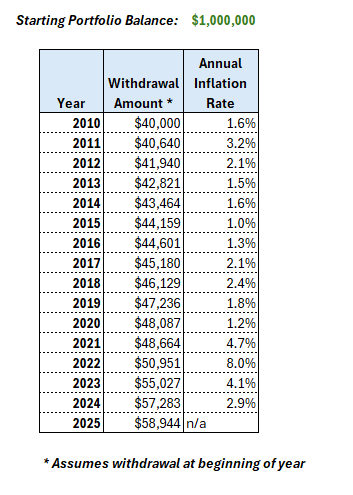
    A simple illustration will clarify. In the chart below, we start retirement in 2010 with $1,000,000. We’ll assume we withdraw on January 1st each year. 

    First Year Calculation

    We calculate our first withdrawal as 4% of our retirement portfolio balance. 
    Portfolio Balance * 0.04 = First Year Withdrawal Amount
    In our example, that’s $1,000,000 * 0.04 = $40,000 for 2010.

    Subsequent Years Calculation

    Calculating the subsequent years is done by inflation adjusting the previous year’s withdrawal amount. This is to make up for the erosion of purchasing power done by inflation. So to calculate our 2011 withdrawal amount, we take 2010’s amount and adjust it for the inflation that occurred in 2010. 

    First, calculate the inflation adjustment.  
    Previous Year Withdrawal Amount * Previous Year Inflation Rate = Inflation Adjustment
    For the second year (2011) in our example with 1.6% previous year inflation, that’s $40,000 * 0.016 = $640

    Next, add that to the Previous Year Withdrawal Amount.
    Previous Year Withdrawal Amount + Inflation Adjustment = Current Year Withdrawal Amount
    In our example, our 2011 withdrawal amount is $40,000 + $640 = $40,640 

    Pro Tip: The shortened single calculation is: 
    Previous Year Withdrawal Amount * (1 + Previous Year Inflation Rate)
    For 2011 that’s: $40,000 * 1.016 = $40,640

    The inflation adjustment is a built-in to Bengen’s research and is a critical part of the 4% rule. It ensures your quality of life isn’t steadily eroded by inflation. But the real freedom-granting power of the 4% rule is its simple answer to the following question: “How much do I need to retire?”. Or more simply put in my case: “Can I Retire?”

    Conclusion: When Can I Retire? 📆

    The real freedom-granting power of the 4% rule is its simple answer to the question “How much do I need to retire?” 

    When I was in a soul crushing job, I had no idea if I could safely leave it or not. The 4% rule gave me the answer in 15 seconds. You just need two pieces of information: your current retirement portfolio balance and your estimated annual retirement expenses. There are two ways to calculate.  

    Method 1: The Maximum Withdrawal Calculator (The 4% Rule)

    This calculation determines the maximum dollar amount you can safely take out annually.
    Portfolio Balance * 0.04 = Maximum Annual Withdrawal Rate 

    • Example: You have a Portfolio Balance of $2,000,000
    • $2,000,000 x 0.04 = $80,000
    • Conclusion: If your annual expenses are $80,000 or less, you can retire.

    Method 2: The FIRE Number Calculator (The 25x Rule)

    The inverse of 4% is 25. This easier calculation uses your spending to determine your minimum required savings goal (your FIRE Number). 
    Annual Expenses x 25 = Minimum Required Portfolio Balance

    • Example: You want to live on $75,000 per year in retirement.
    • $75,000 x 25 = $1,875,000.  
    • Conclusion: Your portfolio must be $1,875,000 or more in order to achieve your goal.

    Summary: Important Caveats

    Both calculations are valuable — one tells you your maximum Safe Withdrawal Rate, the other tells you your savings goal. Before relying on these numbers, it’s important to remember the following about the 4% rule:

    • Time Horizon: Assumes a 30-year retirement. Longer periods may require additional savings.
    • Asset Allocation: The original study assumed a 50% stock / 50% bond portfolio. Many people prefer a more aggressive mix (like 75 / 25 or 80 / 20), which has historically performed well over long periods but carries higher short-term volatility.
    • Annual Retirement Expenses: Determining this can be tricky. Make sure to account for:
      • Healthcare (insurance & expenses)
      • Income taxes (especially if your portfolio is in pre-tax accounts like a 401k)
      • Travel & vacation (you want to enjoy your freedom, right?)
      • Unexpected / irregular expenses (home repair, automobile replacement, etc.)

    For me, this simple calculation gave me the peace of mind to enter early retirement. At this writing, I’m 5 weeks into my early retirement. While I’m still adjusting, I can tell you it is AMAZING. I do what I want, when I want, how I want. Every. Single. Day.  🙂

  • 006 | The Dual Defense: Your Strategy Against Layoffs, Burnout, and Life’s Financial Setbacks

    006 | The Dual Defense: Your Strategy Against Layoffs, Burnout, and Life’s Financial Setbacks

    The Reality of Instability

    In today’s world, stability is a myth and loyalty is a relic. Layoffs, mergers, and industry disruption are commonplace, and employees frequently jump ship to combat burnout or seek better pay. The result is that jobs are less secure than ever, and we must build a strong defense as fast and early in your career as you can. I’m going to talk about two important defenses near and dear to the FI community.

    I worked hard to finish college, get an internship, and land my first full-time corporate job with good pay and benefits. The company was Monsanto — one of the largest, most stable companies in the U.S at the time. I was sure I “had it made” and was so proud to work there. But less than a year in, they announced a reorganization with layoffs. My team was downsized and being the most recent hire, my position was the one eliminated. I was crushed, devastated, and sick to my stomach. Fortunately, I had a good reputation there and a previous supervisor helped move me to another department until the layoffs were over. I then landed a new position on another team. While I had averted this crisis, it was a wake up call. I decided I would start building defenses for the next occurrence. 

    It’s now 2025, and Mrs. Ficology and I have brought 2 little FI’s into the world since then — FIcology Girl and FIcology Boy who are both now young adults. FIcology Girl is in nearly the exact same situation I was: She’s at her first professional job with a large, traditionally stable, worldwide corporation. She’s been delighted to receive this opportunity, been a hard worker, and assumed she had a stable career for as long as she wanted it. They just announced layoffs (womp, womp). While I think she’ll be fine, it’s obviously worrying her. 

    When this situation comes knocking (note: “when” not “if”), it can wreck your life. The rush of negative emotion can be overwhelming. I remember feeling helpless, wondering if I’d ever land another job. I blamed myself for not being good enough or smart enough. I got angry at the company for doing this to me. I felt out-of-control and totally vulnerable. I was devastated in every way. I can’t help but think that FIcology Girl is feeling a little bit that same way right now waiting to see how the layoff lotto plays out.

    Here are two important defenses against job instability that are near & dear to the FI community.

    Defense #1: The Financial Hedge (“F U Money”) 💰

    The term “F U Money” is common in the FI/FIRE community. I don’t know who coined the phrase, but I’ve heard it most from the author of “The Simple Path to Wealth”, J.L. Collins. It means exactly what you think. Basically, you have enough money saved that at any point you can walk away and say “F U” to your employer with little to no worry. There are obviously different levels of F U Money ranging from having 3-6 months worth of expenses saved to being able to fully retire. My suggestion would be to have a minimum of 6 months of expenses saved. Hopefully you have much more than that saved, invested, and growing for you.

    I can’t express enough the freedom that having F U Money gives you. It alleviates all the negative feelings of hopelessness, vulnerability, and so on that we mentioned above. It also opens up a whole world of options to you: mini-retirements, starting your own business, taking additional risks, the confidence to ask for a raise or promotion, and more. Overall, it gives you peace of mind and the ability to sleep at night. And when you have that peace of mind & confidence, it shines to everyone you encounter. People sense this confidence and suddenly start to pursue you with opportunities. 

    How to accumulate is, in theory, simple: live below your means and save the remainder. Where/how to invest F U Money is beyond the scope of this post; it’s a personal decision based on a number of potential variables. I would suggest having 6 months of living expenses in low-risk investment like Treasury Bills or CDs that you “ladder” so that you have a steady stream of income if needed. Savings above that should be invested for growth (equities via low-cost index funds is the FI community’s preference). Once you have more savings/investments, you may choose to have all of it, including your 6-month reserve invested for growth. Once your portfolio is larger, you may perhaps consider the entire balance as your F U Money; I certainly thought this way as I neared retirement.

    F U Money = Time, Freedom, Dignity, Opportunity, and Peace of Mind.

    Defense #2: The Personal Hedge (“U Capital”) 👤

    Just like financial investments, personal investments (“U Capital”) are a great hedge against job instability — and they compound just as powerfully. Make investments in yourself continuously, these make you more valuable to your current employer, potential employers, and anyone around you. There are infinite ways to invest in yourself and build U Capital. Obviously investing in learning more skills at your current career will pay off well, but other skills pay dividends as well. Learning people skills is one of the biggest bangs for your buck. I can’t think of any other thing that would pay off more and across all parts of life. 

    Think about it — if there’s any subjectivity to who gets let go in a layoff, who is going to get let go: an employee that constantly betters themselves and gets along with everyone -or- someone who does the minimum or is a constant pain to deal with?

    Here are some quick and easy tips to get started building U Capital.

    • Be at work 15 minutes early and stay 15 minutes late. This small habit elevates your work reputation above 90% of your peers.
    • Routinely ask your boss for feedback on how you’re doing and what you can do better. As long as you’re sincere, there’s no better way to score legit points.
    • Be promotable. Don’t just expect a promotion; be the kind of person who deserves to be promoted. You demonstrate value THEN you get promoted — not the other way around.
    • Encourage, compliment, and appreciate others including your superiors. All people crave these things and there are few who give them. Be someone that lifts others up.
    • Don’t participate in gossip or negative talk. Course correct conversations if you can by stating the positive. If that’s not possible, exit those conversations. 
    • Multitask learning by listening to audiobooks & podcasts. Listen while you exercise, shop, do chores, or any menial task.

    U Capital = Stability, Career Control, Marketability, and Higher Value

    Conclusion: Compounding Your Defenses 🛡️

    Job instability can rear its ugly head for so many reasons. Hard economic times can force layoffs. Your company could be acquired and you dislike your new owners. You may reach a point of extreme burnout & unhappiness. An accident or medical situation could make you unemployable. A new technology (like AI) could render your job obsolete. Outsourcing to another country with cheaper labor could eliminate your job. The possibilities are endless. That’s why it’s important to build a strong defense as fast & early in your career as you can.

    These 2 defenses work together and complement each other. You need to have both for maximum stability. F U Money absorbs the financial shock, and U Capital minimizes your risk and ensures you land on your feet quickly and on your own terms.

  • 005 | The Urgency of Now: 3 Steps to Instant FI Momentum

    005 | The Urgency of Now: 3 Steps to Instant FI Momentum

    I Get It: Why You’re Ignoring Finance

    Many young people tend not to be interested in the concepts related to financial independence. Things like: investing strategies, tax optimization, expense reduction, etc. I can say this with certainty because I was a young person once. Life is full of wonders, experiences, luxuries, friendships, and pleasures both in the present and those to be acquired. Particularly after completing a college education and acquiring gainful employment, this feels like the time to enjoy life and the fruits of your labor, NOT like the time to spend pouring over budgets, tax brackets, expense ratios, rates of return, and all the other practical subjects that the education system failed to teach us. Plus, that stuff is boring, and you have a fat paycheck coming in now!

    I get it. 

    But, time is the #1 resource at your disposal. Small delays in implementing simple FI concepts can add years, even decades, to your financial independence timeline. And it’s a shame, because these are really BASIC concepts and require minimal effort to set up on 95%+ auto-pilot. It’s like running a marathon, and right when you’re about to win, slowing to a walk 10 yards from the finish line.

    The 3 Steps: Your ASAP Action Plan

    For newly employed young people (or any age, for that matter), the simplest and most effective thing you can do right now for your financial future is:

    • Enroll and set up automatic contributions in your employer’s retirement plan
    • Contribute the maximum allowed amount
    • Designate these contributions 100% into a single low expense total US stock market index fund. 

    That’s it. You could take no further action for the next 10, 20 or even 30 years and wind up financially independent with a fully-funded retirement. Let me make two very important notes about what I’ve said here.  First, there’s MUCH more you can do to accelerate your FI journey than just these things, but they mostly come back to enabling you to do more of these things (i.e .investing). Second, this is blanket advice for most people with 10+ years until retirement. 

    We’ll briefly cover some additional info in this post. But, look for more detail in later blog posts here or in the abundance of information already available in the FIRE community.

    Enroll and Set Up Automatic Retirement Plan Contributions

    Anyone, but especially people with newly found wealth like young college grads entering the workforce, are set up for financial failure in a number of ways. First, you likely don’t have experience managing money yet, so you’re naturally going to be bad at it when it starts flowing into your pocket. Second, we are bombarded 24×7 with ads to buy, buy, and buy crafted by experts on human psychology. These experts are well-versed on the mental & emotional triggers that push us to consume goods & services. We hardly stand a chance resisting them. Third, humans are hard-wired to compare themselves to other humans. And the old saying “comparison is the thief of joy” couldn’t be more true. You’re going to see people that “appear” to be living a better life with oversized houses, luxury autos, vacations, expensive dining, fashionable clothes and a host of tech gadgets. They’ll post all this stuff on social media to portray how wonderful their lives are. But, what social media doesn’t show is that these people often have little savings and are fully leveraged with debt. It’s going to be difficult to not be swayed into increasing your lifestyle to match theirs. 

    That’s the beauty of setting up automatic retirement plan contributions with your employer – they come out of your paycheck BEFORE you ever see it. You don’t have a chance to spend it. Think about it: if you’re coming from no/low income and you land a job making $70k, you’d make it on that and probably be pretty darn happy. But, what if you landed a job making $90k? You’d likely live on that and be pretty happy also. But we’ve already established you can be happy spending a $70k salary. So, why not have that extra $20k automatically invested for you and live off the other $70k? I promise you, it’s WAY easier to limit your lifestyle adjustment up to $70k than it is to try and adjust down from $90k to $70k later. 

    Contribute the Maximum Allowed Amount

    There are times this may not be feasible, and I get that. But you should strive to contribute the maximum allowed amount each year. These plan contributions have huge tax advantages each year. Since these advantages have a “per year” limit and do not carry forward, you never get these tax advantages back. At the VERY MINIMUM, you should invest at least enough to capture any matching contributions that your employee offers. For example, if your employer will match 60% up to 3% of your salary, then the very minimum you should contribute is 3% of your salary. Any less is throwing away free money. 

    Invest in a Single Low Cost Total Market Index Fund

    This topic deserves a blog post all its own, and I’ll do one eventually. Meanwhile, there’s an abundance of information available on this topic in the FIRE community. But for now, just know that if you’re 10 or more years from retirement all you need to do is invest in this single fund. 

    Pick a US total market index fund with the lowest expense ratio from your employer’s plan, direct 100% of your contributions to that, and never look at it again for the next 10+ years (unless you want to). I can’t think of a simpler strategy and in almost all cases it’s more effective than trying to do more complicated investing.

    The Time Tax / The Cost of Delay

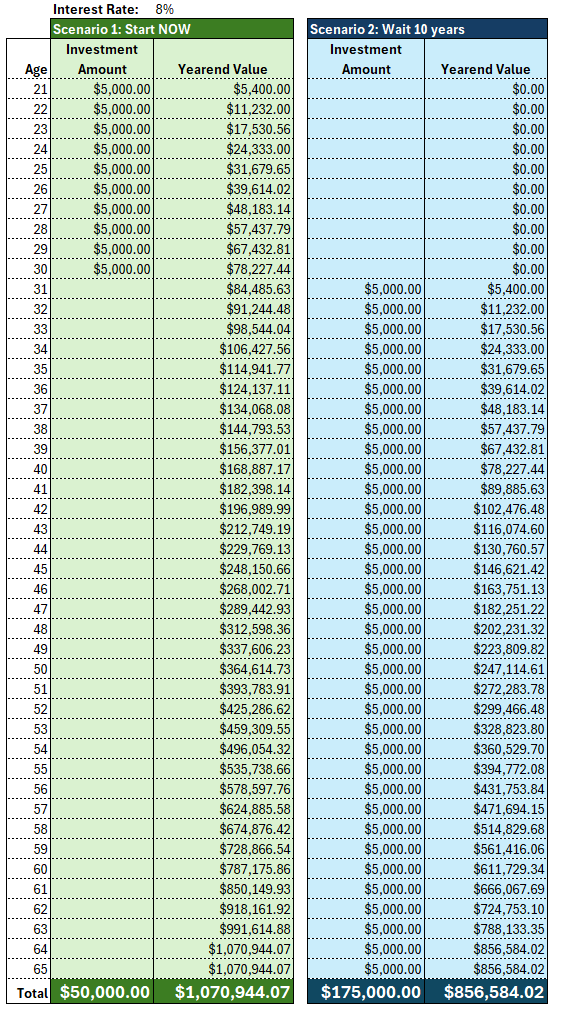
    Why do you need to act ASAP? This is another topic that deserves its own blog post; look for that here soon. The short answer is: compounding is THE magic sauce in the financial independence journey and compounding needs time to work. The sooner you act, the more time compounding has to work for you. Compounding is simple: it’s the snowball effect you get from earnings that accumulate not only on your initial investments but also on previous earnings. The concept is simple. Let’s say you can earn 10% on your initial investment of $1,000. The first year, you earn $100 (10% of $1,000). But since you understand the value of compounding, you leave that new $100 invested and you now have $1,100 to begin year 2. In year 2, you earn $110 (10% of $1,000). And note that you did this with 0 effort on your part. Year 3, you start with $1,210 ($1,000 + $100 + $110) and your earnings jump to $121. You get the idea, simple, right? Despite the simplicity, the human mind can barely comprehend the power of compounding over larger amounts of time. Take a look at the simple chart below illustrating the power of compounding. I used a more conservative interest rate of 8% here. Scenario 1 person invests $5,000/year for the first 10 years, then never invests another penny. Scenario 2 person, waits 10 years then invests $5,000/year for the next 35 years. Despite investing less than a third of scenario 2, scenario 1 ends up with over $200,000 more! This is why it’s crucial to start now.

    6 Psychological Traps Keeping You Broke (and How to Face Them)

    Great question; glad you asked. Every person will be different, but it’s likely any 1 or more of the following reasons. 

    1. We’re instinctively hesitant to act on things we don’t understand. The unknown seems scary and overwhelming, so we avoid it.
    2. People are very private when it comes to money & investing. We’re afraid to ask and people are reluctant to share.
    3. Pride keeps us from asking for help. Whether it’s being afraid of looking dumb or the comparison thing where we’re embarrassed to share that we’re not as far along as our peers.
    4. The news media and investment industry has us convinced that investing is complicated. We’re bombarded with articles and “advice” that successful investing requires extensive knowledge, strategy, timing, and in-depth research. None of this is true. The truth is, the simpler your plan, the more likely you are to outperform the so-called “experts”. 
    5. The stock market’s continual long-term rise is a rocky road of shorter-term ups & downs. This scares people and, in some cases, causes them to look at investing as “gambling”

    Just putting a name to these reasons for inaction is a huge psychological step in helping us move forward. Naming things takes away their power over us. It shines a light on the previously scary darkness. We begin to see them for what they are: simple problems that can be addressed. But, let’s talk some specifics on each.

    For reasons 1 & 2, I’ve given you the simplest, most impactful, single step to take immediately (more on the “immediately” part, later). Just get started here; you can gradually learn more at your own pace over the next 10+ years. 

    For items 3 & 4, this is where the FIRE community comes in. This community is rich with simple & sensible information (books, podcasts, articles) and with people that are glad to help. 

    Item 5 deserves an entire blog post. For now, suffice to say that both the news media and the investment industry stand to make huge profits from you and I. The news media makes massive ad revenue by getting you to click on their articles; learn to ignore them. The investment industry profits by selling you over-complicated investments and/or charging fees on assets they manage for you (usually a percentage of your total value). You don’t need either and having someone skimming 1-3% of your investments is devastating to your financial future. 

    Note: there are times to consult a financial professional. If and when you decide to do that, find one that works off an hourly rate instead of skimming a % of your assets. There are a number of such organizations that have sprung up in recent years as people have started to realize the huge negative impact of giving up an annual percentage of their assets. 

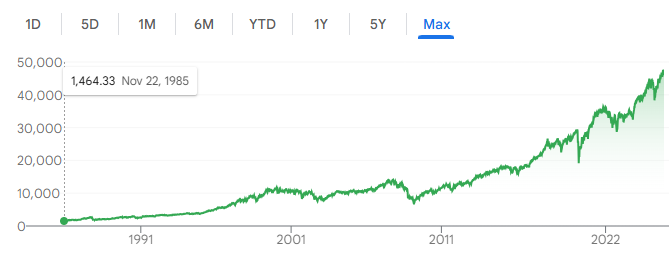
    Item 6 is the simplest to answer but possibly the hardest to follow. The simplest way is to pull up a graph of the S&P 500, Dow Jones Index, or similar and zoom all the way out. Below is the Dow Jones Industrial Average from Nov 1985 – Nov 2025. You can see the trend is always up although the road is often bumpy. You need to get comfortable thinking “big picture” so that you don’t panic and sell during the inevitable down swings.

    Conclusion: Your One-Hour Path to Freedom

    The entire setup — enrollment, maximizing contributions, and choosing a simple index fund — shouldn’t take you more than one hour. The greatest barrier to your financial freedom isn’t the stock market or your income; it’s procrastination.

    If you haven’t started, grab a pen and paper. Ask yourself why not. Write down your specific reasons or fears. Think about each one rationally. Now, review the compounding chart one last time. Can you really afford to wait any longer and keep paying the Time Tax

    Get started now. Don’t wait. This is a “one and done” psychological win that will change your life.

  • 004 | The Ultimate Leverage: Choosing Your Life Partner (Mrs. FIcology)

    004 | The Ultimate Leverage: Choosing Your Life Partner (Mrs. FIcology)

    Introduction

    What does a gainfully employed, now debt-free, young student of FIcology turn his attention to? Leverage, of course! (The romantic kind, actually keep reading.) While we often think of leverage in financial terms, the most powerful multiplier in life isn’t a stock, real estate, or a high-paying job. It’s your choice of a life partner. 

    If you read any self-help or success material, you’ll quickly find teachings on just how important this decision is. There is probably no other advice more simple, more valuable, and more difficult to implement than what I’m about to tell you.

    No decision you ever make will have more impact on every aspect of your life — including your FI timeline — than your choice of a life partner will.

    Captain Awkward vs. The Legion of (Dating) Doom

    Like many, I grew up with fairly low self-confidence, especially where the opposite sex was concerned. Besides being extremely shy and introverted, I was painfully awkward and convinced I had nothing of value to offer.

    So instead of dating, I focused on college, working, and finally getting my life together. This meant I was really inexperienced when I decided to pursue romance at age 26. At this age, the pool of quality, single females seemed slim. It was pre-internet days, so there were no dating sites (although I suspect those have introduced just as many problems as they’ve solved). So, I relied on “set ups” and bars. I think I had the pleasure of landing a date with every type of problem personality: narcissist, spendaholic, drama queen, cheater, etc. to the point I thought it was hopeless. Because I care about people (or maybe just had separation anxiety), it was always difficult to end things. I’d stick them out until I was the one who got “dumped”. This dealt blow after blow to my already fragile ego.

    I decided to look for answers in a familiar place: the self-help section of local bookstores, this time in the “Relationships” area. I devoured some relationship self-help books and learned a lot about people but more about myself. 

    The Unbeatable FI Principle: Shared Values and Goals

    Earlier I mentioned the most important decision in life is the choice of a spouse, the person you will spend your life with. While it’s easy to choose to love someone, spending a lifetime with them is entirely different. 

    Think about it, everything you do will be influenced by this person:

    • Health & Wellness: Diet, exercise, spirituality.
    • Financial Blueprint: Debt, spending, savings rate, investing strategy, and your ultimate FI timeline.
    • Mental & Emotional Capital: Drama, insecurity, emotional baggage, or -ideally- encouragement and stability.
    • Success & Ambition: Time utilization, goals, ambitions, habits, mindset
    • Happiness & Security: Conflict management, personal growth, and creating a safe harbor

    While you can influence another person, you cannot change anyone but yourself. Don’t be fooled into thinking that you’ll train a spendaholic to be fiscally responsible, a cheater to be faithful, a narcissist to care about others, a drama queen to be rational. 

    A Critical FI Lesson: You cannot save a sinking ship. Your attempts to change or “rescue” a financially reckless or fundamentally incompatible person will only drag you down, delaying or preventing your own goals. Recognize irreconcilable differences, cut ties quickly, and move on. It is the kindest path for both of you.

    The Golden Rule of Attraction: Be Your Own Happiness

    Here’s the real truth: happiness can only come from inside you. If you are looking for another person to make you happy, every relationship you will ever have has already failed. Until you’re comfortable with yourself and happy being alone, you won’t be happy with someone else.

    • Cultivate hobbies, join clubs, get in shape, and invest in yourself. Get comfortable in your own skin. 
    • If you’re happy, you’re going to attract other happy people. If you’re not, you’re going to attract the opposite; misery loves company. 

    Next, BE the person that you’re looking for. If you want someone faithful, you can’t be a cheater. If you want someone financially savvy, you can’t be piling on credit card debt. You get the idea. My friend, Jerrod, says it this way: If you want to have a good friend, BE a good friend.  

    Mrs. FIcology: The Unexpected Reward of Self-Improvement

    So months of self-work later, I’ve learned to be happy alone. I’ve got hobbies, new people skills, and genuine confidence (because I’m happy with myself so who cares if I get a date or not?). 

    This self improvement phase led me to a new hobby: country line-dancing. One night at a HUGE bar called “Little Bit of Texas”, I saw the most beautiful girl on the dance floor I’ve ever seen. I mean, I was enthralled. She was tall, beautiful, happy, and fun-loving. 

    I mustered up some courage and embarked on that long walk across the dance floor. The spotlights were on me, and I got to her table only to realize she was no longer there (she saw me coming and ran off to the bathroom!). So here I was, already sick-to-my-stomach nervous, with 5 of her friends staring at me. So, I asked one of her friends to dance. That move scored points with her friends which opened the door for me to return later and dance with the future Mrs. FIcology.

    This was just the start of a quest for the girl of my dreams. During that “quest”, I learned that she checked all the boxes I wanted: single, independent, financially responsible, kind, caring, honest, and the list goes on. At one point, I saw a note she’d kept from her grandmother that said “a penny saved is a penny earned” and “mind your checkbook”. What a treasure!!! One year later we were engaged, and about 6 months after that we got married in Jamaica. As of this writing, I’m coming up on 30 years married to that wonderful girl. 

    The Ultimate Return on Investment (ROI)

    In the FI community, we obsess over metrics: savings rates, returns on investment (ROI), asset allocation, and market performance. But the truth is, the highest-ROI decision you will ever make has nothing to do with money itself.

    Finding Mrs. FIcology didn’t just give me a wonderful marriage; it gave me the most powerful form of leverage possible: Shared Values and Goals.

    • We didn’t have to fight about debt because we were both debt-free, fiscally responsible, and aligned on frugality and saving.
    • We didn’t waste time or energy arguing because we both chose happiness over drama and pettiness. 

    Our journey to FI was accelerated and joyful because Mrs. FIcology was, and is, my partner, not my rival. She doesn’t just support my values and goals; she shares them.

    If you are looking for that ultimate multiplier in your life – the one decision that smooths the path to FI, doubles your happiness, and halves your stress – look inside first. Become the quality person you seek, and then be relentlessly intentional about choosing a partner who provides Shared Values and Goals.

    This is the firm foundation upon which a wealthy, joyful, and truly financially independent life is built. 

    What are you doing today to BE the person you are seeking?

  • 003 | Nineteen Years of School, Zero Financial Clue

    003 | Nineteen Years of School, Zero Financial Clue

    Introduction

    Remember in Blog Post 002 when I said my childhood left me with visions of owning a big house, fancy cars, etc.? Well, the vision I LIVED for, that I DREAMED of, the carrot on my stick, was a fast car. For years, my dad had subscriptions to: Motor Trend, Car & Driver, and Hot Rod magazines. I used to drool over the pictures, the horsepower & torque numbers, the 0-60 & ¼ mile times, and just the pure art & engineering that goes into a well-refined sports car. The one thing that kept me going to finish college was the thought of owning a killer sports car someday. I had the dream car in mind, but no one ever gave me the instruction manual on how to actually afford it.

    College Degree and No Financial Education

    While high school was relatively easy for me, college turned out to be much more difficult. It took me eight years to get a four-year degree. I changed majors, wrecked a motorcycle requiring multiple surgeries and 9 months in a leg cast, dropped out, got involved w/drugs & alcohol, and about every other distraction a young man can find. When I finally graduated, I realized how lost our educational system is, at least where practical life skills are involved. I didn’t know how to find a job or even put together a resumé (I literally thought it was pronounced reh-zoom, lol).

    The biggest failure though, was that after 12 years of public school plus 7 years of college, I didn’t have a single clue at all about how to manage money. Driven by financial ignorance and impulse, the first thing I did once I found employment was buy a shiny sports car on credit. *facepalm*

    That bright white, all-wheel drive, turbo-charged, 1992 Eagle Talon cost me $15,000 on a $31,000 salary.

    Truth Learned Outside the Classroom

    It quickly became clear to me that I was never going to get ahead with my existing money framework. So, I took on my own education. Back then (early 90’s), there was no internet, no Amazon shopping, no YouTube, etc. So, my self-education started the hard way: in the self-help aisles of physical bookstores.

    I devoured books on job hunting, relationships, growth/success, and personal finance. My biggest epiphany: after 19 years of formal education, I learned about interest rates, how to calculate the real cost of borrowing money, and to pay off your highest interest rate debt first. The way I thought about money and spending began to shift. For example, if you pay an extra $100 on a 20% credit card balance, that’s the equivalent of a $20/year TAX-FREE raise. And I could give myself that raise every single month!!!

    The Drastic Steps That Became My Early Financial Education

    As my financial self-education unfolded, I immediately took some drastic steps:

    • I traded the sports car in on a used, fuel-efficient, small truck with a much smaller loan payment.
    • I moved into a modest apartment VERY close to work to save time & commuting costs.
    • I began paying off all my debt starting with the highest interest rate first: credit cards, auto loan, followed by student loans.
    • Weekly, I’d use a calculator to motivate myself to pay off more debt: back to my example of paying an extra $100 on an 20% credit card – if I did that all 12 months, I had literally given myself a recurring $240/year tax-free raise. The more I trained myself to think this way, the more I was motivated to pay off debt, and the faster my net wealth grew. I got totally debt-free, which laid the foundation for the rest of my financial journey and life in general.

    Clarity and Actionable Advice

    The lessons I learned and actioned are learnable and actionable by you too:

    • Don’t let sunk costs dictate your financial path. You can always change course. For me, I bought a shiny sports car on credit. Sure, selling it was going to be a loss. But I already had that loss; I can only move forward. Keeping it, and the debt accompanying, was a worse choice.
    • Determine your debt with the highest interest rate. If you have credit card debt, it’s probably that. If you have multiple credit cards (or other unsecured debt), figure out which one has the highest interest rate. After that it’s probably any automobiles, student loans, and home in that order.
    • Start giving yourself TAX FREE raises right now by paying extra on the debt with the highest interest rate at every opportunity. Don’t think of it as paying a bill, think of it as free money. If I told you about an investment with 0 risk and guaranteed 20%+ returns, would you buy it? Of course you would! Well, that is EXACTLY what paying down a 20% credit card balance is!
    • Shift your mentality. Spend some time with a spreadsheet or a calculator and try some of the following exercises:
      • Big Picture: calculate the total annual interest amount you’re paying. For each debt, take the outstanding balance x the annual interest rate. Add all those together for your total. Example:
        • Credit Cards: $10,000 x 20% = $2,000
        • Automobiles: $50,000 x 8% = $4,000
        • Student Loans: $50,000 x 7% = $3,500
        • Home: $200,000 x 8% = $16,000
        • TOTAL: $25,500
      • Right-Now Picture: calculate how much an extra principal payment of $X would save you right now, this month. Same example as earlier. Knocking an extra $100 off a 20% revolving credit card balance would save you $20 per year / 12 months = $1.67 per month FOR LIFE.

    What could you do with an extra $25k / year?

  • 002 | The Great Depression vs. The Great Debacle: How My Family Created My Conflicting Money Mindset

    002 | The Great Depression vs. The Great Debacle: How My Family Created My Conflicting Money Mindset

    Introduction

    Financial independence is the ability to live comfortably without relying on a paycheck. It involves building sufficient wealth through savings, investments, and passive income streams. In the journey of achieving financial independence, concepts such as budgeting, investing, and wise spending play crucial roles in ensuring financial stability.

    Seeds of Scarcity – Grandparent’s Money Outlook

    My paternal grandparents lived through the great depression which had a profound effect on their relationship with money. They raised 5 kids, the youngest being my father, on a single schoolteacher salary and later by farming.

    My grandmother was tough as nails and while she was never employed, she did more than her share of work providing for the family. They had a massive garden that she tended continuously to cook meals and can for the winter. She kept a full chicken coop, gathered eggs, and harvested chickens for meat. I can still remember her wringing chicken’s heads off by hand and watching the bodies flop around and spew blood everywhere as the last bit of life left them. She’d then hand-pluck the feathers off and slice them up.  

    After years of scrimping and saving, they finally built a very modest house on their farm. It couldn’t have been 1300 sq ft, but to them it was a palace. Even though they were financially secure, their depression-era mindset never let go of them. No shoes were allowed in the house, food was not permitted outside the kitchen, and no horseplay was tolerated. My grandmother kept plastic on all the furniture, plastic runners on all the carpet walkways, and newspaper on the carpet by the sliding-glass door to prevent sun fading.

    Reckless Squander – Dad’s Money Mode

    My father, despite being raised in such scarcity & frugality, was never able to control his money. He was a late-life accidental pregnancy for my grandparents and many years younger than his nearest-aged sibling. I’ve always theorized that my grandparents were too old and tired to raise him with the same level of strictness as the other kids. As such, he grew up spoiled, without rules, and lacking self-discipline. He has smoked marijuana constantly for as long as I can remember and routinely dabbles in other drugs. He got my mother pregnant with me when he was 18 and she was 16. My first few years of memories are of them arguing, my father’s extreme & violent mood swings, my mother leaving, divorce, my mother kidnapping me, reuniting, remarrying, and finally my mother dying of cancer when I was 10 years old.

    Without rehashing all the details, I can summarize by saying that most of my childhood consisted of instability, especially where money was concerned. My father remarried and had 2 additional children. We moved constantly, never staying put for more than a couple years at a time. My father constantly mismanaged money including everything from our food bills to cars & houses we couldn’t afford. Everything was driven by impulse with no thought to the consequences of our future. Each wave of reckless spending and debt would come crashing down as we lost all of it. Him and my stepmother have declared bankruptcy at least 3 times that I’m aware of. He took social security at the first available opportunity (age 62) and they now live off my stepmother’s mother in one-half of a duplex in exchange for caring for her.

    Frankenstein Framework – My Learned Money Outlook

    Given my conflicting money examples growing up, you can imagine the disparate money thoughts floating through my head. I’ve got visions of owning a big house, fancy cars, a boat, a pool and having a family. But the only money tools I’ve been shown are raising chickens and plastic-coating my furniture. And to top all that, what I quickly realized after college is that 16 years of structured education had not taught me a single thing about managing money. What a catastrophic failure of our education system!

    So, there you have it – champagne tastes, a scarcity mindset, and 0 education on anything financial. That sums up my starting point. Now begins the journey of building my own framework, one that balances preservation with progress. What were the conflicting “money lessons” you learned growing up?

  • 001 | Introduction: Breaking Free and Finding the FIRE

    001 | Introduction: Breaking Free and Finding the FIRE

    Introduction

    Even before the official FIRE (Financial Independence / Retire Early) movement exploded, I was fascinated by the idea of early financial freedom.
    While I was unknowingly following some core principles, the FIRE community has advanced the concept far beyond anything I ever imagined. The movement isn’t just about money; it’s a powerful framework for regaining control of your life. It brings together a host of crucial topics:

    • Prioritizing what truly matters in life.
    • Smart money-saving tips.
    • Leveraging travel hacking and side hustles.
    • Deep dives into investment planning and tax strategies.
    • Building effective drawdown strategies for early retirement.
    • And most importantly—a supportive, enthusiastic community of people helping each other succeed.

    My Journey: From Latecomer to “On FIRE”

    Although I’m a latecomer to the official FIRE movement, finding it allowed me to supercharge my journey. I was able to rapidly cut costs, accelerate my investments, and solidify a retirement and drawdown strategy that allowed me to retire.

    Because of this life-changing shift, I’m truly “on fire for FIRE” and want to share my entire journey—the lessons learned, the strategies that worked, and the missteps—in hopes I can help you do the same.

    The Trap of the Status Quo

    So many of us are trapped from an early age by a soul-crushing cycle of consumerism, debt, and corporate bondage. We’re taught that this is simply what you do: you work 40 to 60 hours a week, mortgage a house, finance cars, and buy endless amounts of “cosmic crap” on credit. If we’re lucky, we get to retire after 40 years at age 65.

    Friends, there is a better way.

    I’m here to show you that there’s an exit sign off that path. I’d like to share my failures, my successes, and my continuing journey into financial freedom with all of you.

    Welcome—and thank you for reading. Let’s start building a better future together. What does “Financial Independence” mean to you right now?