
Welcome back! We’re wrapping up our four-part series on tax bracket arbitrage (TBA). In Part 1, we introduced tax bracket arbitrage and the tools available. In Part 2 we discussed the accumulation stage of your FIRE journey. In Part 3 we discussed early/partial retirement and here we’ll talk about the full retirement phase.
Writing this series has been an eye-opener for me. The base concepts are relatively simple. But the number of variables to consider (age, marital status, income level, tax brackets, mix of different savings buckets, etc…) makes strategizing complex. The number of possible scenarios is seemingly infinite. It’s been challenging to provide useful and actionable information while maintaining a simple and digestible format to fit the potentially vast variety of readers.
Full Retirement Stage
For our purposes, we’ll define full retirement as any time after age 59.5 that you leave full-time employment/wages. While you may choose to supplement your income with part-time work or other income, you’re likely drawing down your retirement nest egg. The significance with age 59.5 is that this is when you can withdraw from tax-deferred retirement accounts without penalty (in the U.S.).
The goal in this stage is to enjoy life and make your savings last the rest of your life while minimizing present and future tax burden. Like all stages, each person will have their own unique situation, savings, investments, and spread across the 4 main buckets. This means your specific strategies will be unique to you.
TBA Strategies
Similar to the early retirement stage, in this stage of the FIRE journey we’re all in unique and very different situations. As before, there’s no one-size-fits-all strategy, here are multiple facets to consider, and we’ll keep it simple here. In many ways, the strategies are the same/similar as for early retirement. The main difference is that, because we’re aged 59.5 or later, we have access to our tax-deferred buckets without penalty.
Gathering Data
Before we start, you’ll need to gather the following info. (This is the same info we gathered Part 3, repeated here for convenience.)
- Annual income sources and amounts. In order to have a strategy, you absolutely must know all your income sources (wages, interest, dividends, etc.) and be able to project those amounts each year with reasonable accuracy. Unlike the early retirement phase, you may also have pension or social security in this phase. Include those as well. Do NOT include retirement savings drawdowns in this number.
- Savings balances by bucket type. Because each bucket type has its own tax rules, summarize your savings amounts by bucket type. See The Four Buckets for more information.
- Applicable U.S. income tax brackets. The simplest way is to just use google. Search “2026 US tax brackets”, for example. Don’t forget state taxes, if applicable.
- Applicable U.S. capital gains tax brackets. Long-term capital gains (gains on investments held more than 1 year) are taxed differently than short-term capital gains (gains on investments held 1 year or less). Note: qualified dividends are also taxed at long-term capital gains rates; that discussion is beyond the scope of this article.
- Applicable U.S. standard tax deduction. Again, just use google to find this. Note: If you itemize deductions (very few people do thanks to generous standard deductions), use your total itemized deductions instead.
- Annual lifestyle expenses. This may be the toughest data to get, but it’s worth it. Estimate your annual expenses by category, if possible. At minimum group into discretionary and non-discretionary.
Strategy
The strategy in full retirement is largely the same as the early retirement phase. The process below will need to be repeated annually. Life is always changing and each year will have unique expenses, incomes, tax brackets, and so on.
Step 1 – Calculate Required Annual Drawdown
Calculate the amount you’ll need to pull from your savings. This is simply the difference between your total annual income and your annual lifestyle expenses.
Note: if your annual income sources include things that will not be used as income (example dividends that are set to reinvest), exclude those from the total annual income.
Annual Drawdown = Annual lifestyle expenses – Annual income
Step 2 – Determine Marginal Income and Capital Gains Tax Brackets
Using your annual income, applicable tax brackets, and applicable standard deduction, find your marginal tax rate(s). For more info see our post on Marginal vs Effective Tax Rates.
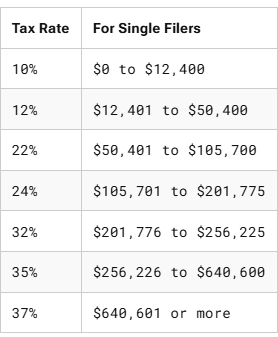
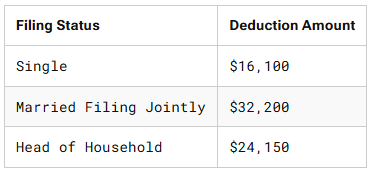
For this example we’ll use the 2026 single tax brackets (below) and standard deduction of $16,100
2026 Tax Brackets – Single Filers
2026 Standard Deduction
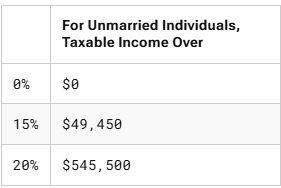
2026 Capital Gains Tax Brackets – Single Filers
For a quick example, let’s assume you have $30,000 in annual income.
- $30,000 annual income
- – $16,100 (standard deduction)
- = $13,900 taxable.
Using the charts above, we see you’re currently in the 12% tax bracket and the 0% capital gains tax bracket before making any withdrawals.
Step 3a – Determine Withdrawal Strategy that Minimizes Tax Burden
This step is more complex and depends on which of the Four Buckets you have to pull from. Generally, you should be pulling from your Tax-Deferred account to the point you are in a low/no tax bracket. This has 2 benefits: first it gets your money out with little to no taxes and second, it reduces potential RMDs (Required Minimum Distributions) later. Next, pull from your Taxable account — you are only taxed on any gain, not the principal. Since Roth accounts are tax free forever, only pull enough from there to meet your needs while keeping taxes low from Tax-Deferred and Taxable account withdrawals.
Bucket Withdrawal Review
Following is a brief review of each bucket pertinent to this stage.
- Tax-Deferred – money pulled from here is taxable as normal income. So, prioritize pulling from here, but only if you’re in a lower tax bracket. (Optional: you can do Roth conversions instead of pulling the money out, see Step 3b)
- Taxable – this is likely your 2nd goto bucket for withdrawals. But, if you need to sell investments before withdrawing, you will pay capital gains tax on any gains (sale price – purchase price). Only do this if you’re in a favorable capital gains tax bracket.
- Roth – this is likely your 3rd goto bucket. Withdrawals from here are now 100% tax & penalty free. Use this just enough to keep the amounts pulled from Tax-Deferred & Taxable accounts low enough to minimize taxes.
- Health Savings Account (HSA) – if your annual expenses include healthcare costs, consider pulling those costs from this bucket. Qualified withdrawals will not generate any taxes or penalties.
If you need to sell investments in your Taxable account, you will pay capital gains on any increase in value (sale price – purchase price). Note that the capital gains brackets are much more generous. For a single-filer, you pay 0% on capital gains up to $49,450 total taxable income. Continuing our example above, you can realize an additional $35,550 in capital gains and still pay 0% tax.
Pro Tip: Since you’ll likely start getting Social Security benefits in this stage of life, it’s important to note that those benefits count as income (although they are taxed differently). In 2026, the average Social Security benefit is approximately $2,071 per month. If this is your only income, you are effectively starting the year with roughly $24,852 already ‘filling’ your 0% and 10% tax zones. Always check your Social Security taxability before deciding how much to pull from other buckets.
Step 3b – Roth Conversions
If your income puts you below the 10% tax bracket (i.e. you’re paying 0 taxes) and you have money in a pre-tax bucket, consider doing a Roth conversion at least up to the point you fill up the standard deduction. Depending on how much pre-tax money you have, you may want to even consider doing Roth conversions into the 10% and 12% tax brackets.
Briefly explained, Roth conversions are a special tax loophole that allows you to convert money from Pre-Tax accounts to Roth accounts without penalty. However, you do pay income taxes.
But if you’re below the 10% bracket, you could convert up to that bracket and effectively never pay income on that money or its earnings.
Important: Since Roth conversions count as regular income, make sure to consider impact to any capital gains realized from Step 3a and any other withdrawals from Tax-Deferred accounts.
Also Important: Roth conversions are beyond the scope of this article. There are other restrictions and rules to be aware of that may apply. Please research this in detail or talk to a tax professional before making any decisions.
Step 3c – Consider RMDs
RMDs are Required Minimum Distributions from your Tax-Deferred accounts. It’s Uncle Sam’s way of making sure he gets his tax money. Beginning at age 73 or 75 (depending on your birthdate), the government requires you to begin pulling a % from your tax-deferred accounts on a schedule that they determine. The gotcha here is that if you have a lot in tax-deferred accounts, this can force you into a higher tax bracket. Therefore, it behooves you to be thinking about this ahead of time to consider withdrawing from these accounts sooner, while you can control the tax bracket, rather than later where Uncle Sam forces your hand.
NOTE: RMDs are beyond the scope of the article, but mentioned here for completeness.
Conclusion
Because of the wide range of possibilities and individual circumstances, it’s impossible to give any one strategy. The goal here is to equip you with the starting information to begin thinking through your personal situation. Take the time to gather the information outlined above and begin thinking about how you can minimize your tax burden. The effort is well worth it!
Congratulations on completing the 4-part series! This has been a learning experience for me and I hope it has been for you. There is a lot of complexity in retirement tax planning and strategies are heavily dependent on individual situations. You’re now equipped with the necessary concepts to put together your own plan.